Wednesday, December 12, 2012

Assignments, etc. for Final Days of ENG 241

Outside of polishing your draft of your final learning reflection, there is no new reading or writing due these final days of class.  I want to give you a chance to finish up all work and to publish your best work for your final grade. You can find a checklist of all work due in a post below or by following the link this link:


Remember, you can continue to submit to committee discussions until midnight on Saturday, 15 December, and you can continue to revise and update your blog's essays, extra-credit, and learning reflections until midnight on Saturday, 15 December.

Make sure to write with any questions, and I will have a couple of final class announcements and lectures to post.  All-in-all, we've had fairly good coverage of what can only be the tip of an iceberg of literature.

I am looking forward to reading your final learning reflections and what you put together as the final edition of your blog.

As always, I am here to answer questions.

Steve  

Checklist of Assignments Due Arranged by Week

Below, I've excerpts a short checklist of all work due to your blog or discussion posts throughtout the semester. In these final days, I don't want to assign new reading; instead, I want to give you a chance to bring your work up to date, post missed assignments, and polish your final learning reflection. Saturday afternoon, 15 December, I will begin grading. Make sure to write with any last minute questions, and make sure to post pictures and reviews of any extra-credit you have done into your blog.

Thanks,

Steve


Week Twelve: The Literature of Spanish Colonialism (1492-1640)
  • Draft of Final Learning Reflection to Blog (1000-1250)
  • Committee Discussion: What Early Ame. Literature Should be Widely Known and Taught?”

Week Eleven:  The Literature of Early and Late Virginia Colonialism (1570-1720)

  • Blog Post Compare and Contrast Early Indentured Service Literature to the Diaries of William Byrd, II--a plantation owner 100 years into Virginia settlement.
  • Committee Discussion: New Virginia and Virginia as Frontier.
  • Pre-writing and collection of notes for final learning reflection.

Week Ten: Fall Break

Week Nine: The Literature of the Founders (1740-1790).  Jefferson, Franklin, Edwards, and Paine
  • Committee Discussion:  The Founders, the Bill of Rights, and the Separation of Church and State
  • Blog Post (500 words).  Explain and discuss two religious beliefs you share with the authors we have read and which were in wide circulation in the colonial and Early Republic period.
  • Blog Post: Learning Reflection on reading, discussion and writing.

Week Eight: The Literature of the Late Colonial Period, Revolution, and Early Republic (1777-1801).  Bill of Rights, The Federalist Papers, Jefferson’s “Inaugural Speech” and “Statute for Religious Freedom,” and Patrick Henry’s “Give Me Liberty, or Give Me Death.”
  • Committee Discussion:  
    • Part A:  What Civil/Public Virtues Must a Democratic Republic Cultivate
    • Part B: a la Franklin, what private/personal virtues must we cultivate to live the good life in American society.  How can we best cultivate them?
  • Blog Post:  List of Virtues you want to cultivate in your life with short definitions. See Franklin’s Autobiography and his “bold and arduous” plan.  Note: this is a list, not an essay.

Week Seven: Hurricane Sandy, Catch Up Week.

Week Six: The Romantic Literature of Social Reform: Abolitionism (1770-1860).  Harriet Jacobs, Henry “Box” Brown,” de Crececoeur’s letter from Charlestown,  Franklin’s “On the Slave Trade,” Thoreau’s “A Plea for John Brown,” and George Fitzhugh from Southern Thought.
  • Blog Post (500-750 words).  Current Social Problems in Need of Reform.
  • Committee Discussion: American Romantic Literature of Social Reform: Discussion of Contemporary Literature of Social Reform.

Below find the checklist of Assignments for weeks one - four.  This is from the class announcement for 10 October 2012:

Here's the promised checklist:


Checklist of Assignments by Week:  Weeks One-Four

Note:  Detailed descriptions and discussion of each reading and writing assignment can be found in the weekly assignment descriptions on the “Weekly Assignments” tab of eng241fall2012.weebly.com.  This is where you find out what to read and write about and not just what is due.

Week One:  Unless otherwise stated, all work is due on Monday at midnight following the Tuesday it was assigned.  Because students are still joining the class the first week, work for week one was due Monday, 2 October at Midnight, but--if possible--you should try to complete it by Monday, 24 September at Midnight.  
1.  Purchase texts for the course.
2.  Set up personal gmail account.
3.  Share the email address of the personal google account you will use for the class.
4.  Explore eng241fall2012.weebly.com, that is, the site used to implement the class.
5.  Read assigned literature for the coming week.
6.  Find your committee of correspondence assignment for the semester on the “General Assembly” tab of the class webpage.
7.  Under the week one discussion thread for your committee, post an introduction of yourself and in a follow up response, discuss possible extra-credit you might be interested in sharing with your committee.
8.  Read all class announcements.
9.  Write Dr. Brandon with any questions.   


Week Two:  All work due on Monday, 2 October at Midnight.
1.  Create a blog you will use for the course.  On this blog, you will post short essays and learning reflections you will write.  Blogs are created, so your committee can have easy access to you writing for comment and to help them learn.  Blogs will also be used to help you learn about the revolutions in literacy (the move from an oral to a print culture) and the impact of cheap printing on creating American literature and America.
2.  Using an online form, share the web address of the blog you create.
3.  Post to your blog an essay of ~750 words in which you describe America and what it means to be America.  In your essay, use the reading from week one as a source to drawn on.
4.  Read all class announcements.
5.  Review the literature and announcements from Week One.  
6.  Read all assigned literature for the upcoming week.  
7.  Explore the extra-credit for Edgar Allen Poe, found under the “Extra-Credit” tab.
8.  Under the Week One discussion thread in your committee’s coffee house forum, continue to introduce yourselves and discuss possible extra-credit.
9.  Write Dr. Brandon with any questions.


Week Three:  All work due by 8 October at midnight.
1.  In a post to your committee’s Week Three, Part One discussion thread, compare and contrast your committee’s essays on America and what it means to be American to that of de Crevecoeur's essay.  Your committee’s essays were posted to their blog on week two. Links to your committee’s blogs can be found under the “General Assembly” tab.  Over the next couple of weeks, make sure to write follow up responses to at least two of committee member posts.
2. In a post to your committee’s Week Three, Part Two discussion, create a post in which you describe your moment of the Romantic sublime.  Over the next couple of weeks, write follow up responses to your committee’s initial posts on their sublime moments.  
3. Read Emerson’s essay, “Self-Reliance” for this week.
Post to your blog a 500-750 word essay in which you describe your best self.  In your essay, use Emerson’s “Self-Reliance.”
4. For next week, read Thoreau’s “Walking” and “Where I Lived, and What I Lived For.”
5. Read class announcements for the week.  
6. For attendance purposes, fill out a questionnaire/survey.
7. Write Dr. Brandon with any questions.

Week Four:   All work for this week is due by Monday, 15 October at Midnight.
1.  Read all class announcements/lectures.
2.  Review Thoreau’s “Walking” and “Where I Lived, and What I Lived For” from week three.
3.  Read background literature for coming week.
3.  To your week four committee discussion thread, post one response to the discussion topic and at least two responses to what other committee members have to say.  
4.  To your blog, create a post containing a learning reflection.
5.  To your blog, create a post containing a short, ~500 word essay.  
6.  Write Dr. Brandon with any questions.

Thursday, December 6, 2012

Week Twelve Assignment Descriptions and Committee Discussions Now Active

Week Twelve, we make the final steps backward in our journey to understand Early America. All of this week predates the United States, the Revolution, and late British colonialization  This week's reading deals with Spanish Conquest and Colonization (1492-1640).  

As you will discover, Spanish Conquest and Colonization was fundamentally different than that of the British.  The Spanish had two intertwined models of colonialization.  One established missions to convert Natives to Catholicism and--as a related by product--Spanish subjects.  Please note the use of subject as opposed to citizen.  The second model was one of out right conquest, which allowed grants to newly created nobles and  made Natives into what were, in essence, serfs or slaves.  In turn, this new aristocracy created echos of Old Spain, and this included work to convert the nations to Catholicism--the state church of Spain.   

Week Twelve will also give you a very brief glimpse into the Native literatures, societies, and traditions which    continue into today, were changed by contact, and in the process informed everything American society became.  

Enjoy, and write with questions.

Steve

Native America and Native American Literature

As background to the literature of British and Spanish Colonization and Conquest, we must never forget that the land which became “America” was already discovered, already settled, and the United States continues to colonize tribal nations.  To give you some idea of the land and people prior to contact, watch part 1 of “500 Nations” (Youtube Link Below).  Unlike most Western literature, Native literature was mostly oral, so pay particular traditions to the creation stories shared and to the people telling stories to explain Native culture and society.  The section on the Ancestors tells the story of the people who became the Acoma and offers another perspective on the story of the Spanish Conquest of New Mexico.  The section on the Mound Builders tells the story of the society which would develop into the people contacted by the early Spanish and British settlers of North Carolina and Virginia.   Also notice the contrasts between Native cultural outlook and that of the settlers.  Most Natives came from a world view which believed they were in the best of all worlds already.  Most settlers were seeking a new and better world and attempting to create it in what became America.


Thursday, November 29, 2012

Week Eleven: Assignment Descriptions and Committee Discussions Now Active

I hope everyone had a safe and enjoyable Thanksgiving Break.  With this week, we enter the last weeks of the class, and we again step back in time and we move south to the colonialization of Virginia.  This week, you'll be reading excepts from a diary of a Virginia Planter/Founder of Richmond (1709-1712), a description of Virginia (1649), a letter home from Virginia from an indentured servant (1623), and a ballad from a felon transported to the Virginia colony.

You will be writing a short essay in which you compare the life described by the early colonists to that described by the planter in 1711, and in your committee discussion, you'll be exploring the reasons you might become a planter on a new world.  Finally, you will begin prewriting and taking notes for an essay in which you detail what you have learned in this semester's work in Early American literature.

In this week's reading, I think you'll be surprised at finding the Falls of Richmond the edge of the known, British world and amazed as you read one of the first published descriptions of plans for a British expedition to the South and West of the falls.  Hopefully, over the course of the week, you'll gain some insight into the minds of those who colonized Virginia from Britain and the kind of colony you might expect to find along the James River 40, 65, and 100 years into Virginia's settlement by the British.

In all your reading and thinking, remember that while the British thought of this as a Virgin Land and a wild frontier, this land was already long settled, farmed, and inhabited by those who would be displaced by the British.

As always, write with comments.

Steve    

Friday, November 16, 2012

Possible Extra-Credit Over Thanksgiving.


Below are some extra-credit opportunities you can consider reviewing for extra-credit in Early American Literature.  Remember, to qualify for extra-credit.  You should review the opportunity in your blog, explaining what you learned, connecting what you learned to the time period and literature we are studying, and include pictures of you participating in the opportunity (where appropriate).

1.  Over the remaining weeks of the semester, we will be studying the early colonial period and concentrating much of our reading on British Colonialism in Virginia.  Now is a good time to plan a visit to Henrico, Jamestown, Colonial Williamsburg, one of the James River plantations, etc.

2. The Smithsonian's American History Museum has an exhibit open on the move west.  In the lobby, there's one of the few surviving Conestoga Wagons--the preferred method of transportation moving west and moving cargo in the Early Republic during westward expansion.

http://blogs.smithsonianmag.com/aroundthemall/2012/11/going-west-the-american-history-museums-conestoga-wagon-is-a-must-see/?utm_source=feedburner&utm_medium=feed&utm_campaign=Feed%3A+smithsonianmag%2FAroundTheMall+%28Around+The+Mall+%7C+Smithsonian.com%29

While at the American History Museum, you might go to the presidential exhibit and view the lap desk on which Jefferson composed the draft of the Declaration or go next door to the US Archives to view several of the founding documents in person.  If you go up the hill, to the Jefferson building of the Library of Congress, then you can see what remains of Jefferson's library, that is, the library Jefferson sold to Congress after their library was burned in the War of 1812 and which was the seed of today's Library of Congress. While on the floor for this exhibit, you might walk across to see the first map (1507) which calls the New World "America."

3.  If you would like to stay closer to Richmond, consider taking in the movie, Lincoln, which opens this weekend and taking a tour of Shocoe Bottom.  While there, see where Madison argued the General Assembly to ratify Jefferson's Statue for Religious Freedom, see an early draft of the Declaration (in the Statehouse Jefferson designed), sit in a replica of Henry "Box" Brown's box (on the Canal Walk/Slave Trail under I-95), walk the Slave Trail, and visit the Poe Museum.  All this is within a few blocks of one another, and each can earn you two points extra-credit, that is, with pictures and a review posted to your blog.

4. For those who want to stay in Richmond and don't mind a short drive, consider visit to a slave cemetery and Lumpkin's Jail, St. John's church on Church Hill, Tocahoe Plantation (where Jefferson went to school), the Confederate Whitehorse, etc.

The point is to connect what you are learning via the literature to your daily life and the landscape surrounding you.  In the process, you'll pick up some good Thanksgiving conversation and stories about Richmond and Virginia to share.  You might even be able to turn one of these visits into a family outing 

Regardless, have a safe and enjoyable Thanksgiving Break.

Steve 

PS Legal Stuff:  As always, participating in an extra-credit opportunity is your choice and is not a requirement for successful completion of the course.  The college, VCCS, me, etc. cannot and will not take responsibility for anything which happens to you as a result of taking an extra-credit trip.  These trips are designed to help you supplement your learning in the Early American class and to provide connections which might help the learning stick. I hope they might also make early American literature more fun and demonstrate how the subject remains a part of our daily lives--especially in Richmond and Virginia.

How Saving $2.75 a Day Can Change Your Life, or a Modern Version of Franklin's "A Way to Wealth."

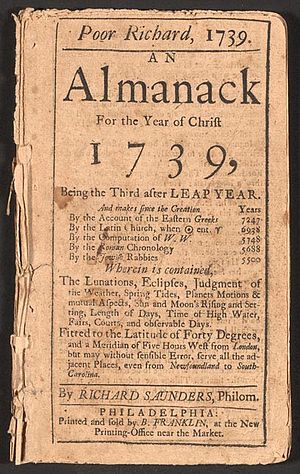
In writing and publishing Poor Richard's Almanac and "The Way to Wealth," Franking introduced the American "common man" to refining the virtues of industry, frugality  and saving.  Yesterday, a modern example of the same rhetoric crossed my inbox.  Follow the link to find a discussion of just how much you pay to borrow $1000, and how rich you can become by saving only $2.75 a day over time.

http://lifehacker.com/5960927/how-saving-275-a-day-can-change-your-life

It's good advice, but--as Farther Abraham says in "The Way to Wealth," I wonder how many will follow the advice.  In any event, it is advice that will greatly profit you and a path to wealth which is within the capability of many college students.

Finally, the article is a point of proof that self-help and the notion of the individual using reason and self-discipline to improve their life did not end with the Enlightenment and the Romantics.  The tradition remains a daily aspect of American culture, and it had its roots in the Founder's generation and--especially--Franklin.

Steve

It is the Great Turkey, Charlie Brown, or the Myths and Facts Surrounding a Pilgrim 1621 "Thanksgiving" Feast


Many of the traditions which have built up around the Pilgrims and Thanksgiving are myths, but there is some truth buried in there.  Follow the conversation and link below to read what are taken to be the only reports of a harvest feast in 1621.

What we are pretty sure of was that the harvest of 1621 produced hope and food for the coming winter.  We have one surviving report of Massasoit--the Wampanoag shaman showing up with a group of Indians and killing some venison to share with the Pilgrams. We are very sure this three day get-together and feasting did not happen on 25 November 1621.  Still, 1621 would be the first time the Pilgrams took in a harvest and felt prepared for winter, and their having enough food (largely Indian Corn and seafood) was largely a result of the help of Indians, like Squanto and Massasoit, who introduced NDN corn, lessons on how to grow NDN crops, and how to harvest the local plenty.

Follow the link below for some of the facts about the history of Thanksgiving: 

http://www.mayflowerhistory.com/History/thanksgiving.php

Steve

Wednesday, November 14, 2012

Seeing Stephen Spielberg's _Lincoln_ as Early Ame. Extra-Credit.

This week, on 16 November, a new production of the life of Lincoln will open nationwide. It's put together by executive producer, Stephen Spielberg, and the movie was shot this past year in Virginia.  Since you've read Lincoln for our Early American class ("The Gettysburg Address," etc.), and--in particular--you read some of the Enlightenment and Romantic literature surrounding the Abolition of slavery in the United States, I thought I would offer two points extra-credit to those who go to see the film and used it as an opportunity to learn more about the literature and about Antebellum America and Civil War America.

As always, to earn the extra-credit, there should be a photo of you helping to "prove" you went to see the movie, maybe standing in line or getting popcorn.  Also, to earn extra credit, write a short review of the film and how it helped you learn about the Early American time period, the literature we have read, or Lincoln as an author.  Post the image and your review to your blog.

Steve

Week Nine Assignment Descriptions, Reading, and Committee Discussion Threads Are Active.

In today's America, we tend to talk about "the founders" as if they were a single group, ones who shared similar beliefs, similar lifestyles, and a similar vision for America.  As you read last week, politically there were stunningly different visions for America and the United States.  Some Federalist, like Hamilton, didn't want something as foundational as our Bill of Rights to be added to our Constitution.

This week, you will continue reading literature which reveals how fundamentally different various founders and colonies were in their religious beliefs.  You'll find that many (most) of the radical founders--like Jefferson, Franklin, Paine, Monroe, etc.--were Deist, and they worked to create a unified society which could accommodate wildly differentiated religious and political belief systems.

This week, you'll have the chance to review the major belief systems in circulation in the late British Colonial period and some of the literature written about religion (and it's place in society) by several of the more influential founders.  You'll also have a chance to find out that anytime someone speaks of "the founders," you should be wary.  Just as there is no one way to be American today, there was no one way to be a member of the founding generation.  Beliefs differed.  What was shared was--in general--an optimism that people could build better lives, that is, if they were left free to do so.  Also shared was the value of bringing together people to benefit from everyone's wisdom

Enjoy, and--as always--contact me with any concerns and questions.

Steve

Sunday, November 11, 2012

The Forum is Back Up: Sunday, 6:00 PM, 11 November

After being down for maintenance by Tal.ki for a few hours today, the Committee Forum is back up and running.

Steve

The Committee Forums seem to be down for maintenance.

This morning (Sunday, 11 November) Margaret wrote to let me know the committee forums were offline.

I assume the company who hosts the forum--Tal.ki--has taken some weekend time to do maintenance on their servers, and I am monitoring the situation.  I am hopeful this is very temporary, as the forums were up as of yesterday morning.  If they don't come back up soon, I have a fall back host to put in place.

In the meantime, if you were planning on working on the forum on Sunday, 11 November, please draft initial responses to the forum, so you'll be ready when the forums come back online.

Steve  

Friday, November 9, 2012

Week Eight Assignment Descriptions and Discussions Are Now Active

Week Eight. Looking Back and Looking Forward. The Literature of the Late Colonial and Early Republic.

Overview:

This week, we enter both the final quarter of Early American Literature and the final month of the course.  


We are looking at the literature surrounding the founding of the United States of America, and--this week--we’ll begin to discuss the literature surrounding the British Colonies.  The reading you began two weeks ago, that is, Benjamin Franklin’s Autobiography laid the groundwork for understanding the literature of the founders and much about the later British colonial period.

Let’s take a moment and reflect on What You Have Learned from Reading Franklin about the Late Colonial and Early Republic periods:

1.  The British colonies brought together in the United States were very different places.  They had different currencies, different assumptions about how religion should be practiced, and even different ideas about what bread should be produced as a staple.

Remember Franklin entering Philadelphia?  He found himself unable to buy the bread he was used to buying in Boston; he ends up asking for a penny’s worth of bread, and he finds that his money will go much further in Pennsylvania--which has more extensive grain production--than it had in Boston.  He ends up with three large loaves of bread and has to give two away--all because things as common as types of bread and money worked differently in Philadelphia than in Boston.  Today, we can drive between Boston and Philadelphia in six hours, but for Franklin and other colonials moving from the Massachusetts Bay Colony to the Colony of Pennsylvania took up to a week and it meant to adjusting to a very different culture.  

2.  The second lesson you can pick up from Franklin is that the colonies needed each other, and they needed some means of coming together and supporting one another.  You might remember that Franklin was responsible for producing the first plan for bringing the colonies together for common defense.  In the process, he published one of the first political cartoons in the British Colonies.  Chances are, you remember this cartoon.

Often, we associate the cartoon, “Join or Die,” with the American Revolution, but Franklin produced it twenty years prior to the Revolution.  He published the cartoon in 1757 in response to an earlier war--The French and Indian War.  The American Revolution wouldn’t begin until the early 1770s.

During the French and Indian War, each colony has its own military.  The point of the cartoon was to remind everyone from the individual colonies that, despite all our differences, we needed each other.  Individually, a superpower--like France--combined with a coalition of Native Nations might easily defeat any one colony fighting alone.  

In fact, the only way that the combination of the French and Indians were finally defeated was when Britain sent troops over to defend the British colonies, who refused--at the time--to adopt Franklin’s plan to come together for mutual defense.  From Early AMerican History, you might remember that George Washington’s first major job was in the French and Indian War.  He led a group of Virginia militia, and the Virginians were soundly defeated.  Trying to stand alone, the Colony of Virginia was not strong enough to fight an European superpower.  

Of course, those living in England resented their taxes being raised to protect far away colonies in America, and those from England lobbied Parliament to tax the colonies for defense.  Eventually, this taxation of the British American Colonies without allowing the colonists representation in Parliament became another stepping stone toward the British Colonies declaring independence and imagining their self as a nation.  

The late colonial period and early Republic were a time of change.  In less than twenty years, France would become the America’s major European allie and the superpower who helped defend the emerging United States, and Britain, who had once defended the disunited colonies against the French, would became the enemy.

3.  The social mobility demonstrated by Franklin was possible and usual only in late colonial America.  You might have noticed that Franklin began his Autobiography by saying his people (his ancestors) were all dyers, that is, craftsmen who produced dye and dyed fabric.  In England and on the Continent, a young man usually entered into the family trade.  In America, things were different, and Franklin goes from being a craftsman--a printer--to being wealthy, to being an inventor, to being a statesman.  

The key insight here is that in late colonial America there was constant demand for workers.  The economy was constantly expanding, so almost any individual could gain relative wealth, that is, if he or she had industry, a certain degree of luck, and was willing to save and work.  Here, you might hear echos of Franklin’s essay, “The Way to Wealth” and from the Autobiography.  Quite literally, Franklin used writing for others and writing about himself to share a new vision of the life of the individual--what we speak about as the American Dream, and this vision was radically different from that practiced for centuries in Europe.  These changes would make many very nervous, and they would look to the stability offered by religion to help them deal with the stress of social change the new world represented.   Others, like Franklin, embraced changes wholeheartedly, and argued even more radical changes were needed to almost every aspect of life, including religion.  Hence, Franklin will argue that the individual could use reason to form a plan to cultivate their own virtue, just as they could cultivate other paths to wealth and happiness.  

This mix of people worried about the pace of change with some wanting to speed it up and others wanting to slow it down was volatile.  Once it was accepted that it was allright for people to read, converse and think for their self, a new tradition began.  People shared reason and followed reasonable “Common Sense.”  Each needed to be convinced that radical social change was good idea, and the literature of late colonial period is one of arguments from visions of how to restore the social order of the mother country to proposing ever greater change based on reason.

Tuesday, November 6, 2012

Week Eight Assignments will be posted on Wednesday, 7 November.,

As you've found out in reading the Bill of Rights, it's a privilege to vote and participate in the formation of one's government,  but it's a time consuming process.  I am just getting in from my polling place, and I will be a day late posting the Week Eight assignments.

I did, however, want to get you started with one of the reading assignments for the week, namely, Tom Jefferson's First Inaugural Address.  As with so much early American Literature, it has a lot to teach us about how the United States is supposed to work, and this short speech speaks to how we put divisive campaigns behind us and get back to the business of building a free society together.  In particular, pay attention to the following passage.  A link to the whole speech follows the passage:


"During the contest of opinion through which we have passed the animation of discussions and of exertions has sometimes worn an aspect which might impose on strangers unused to think freely and to speak and to write what they think; but this being now decided by the voice of the nation, announced according to the rules of the Constitution all will, of course, arrange themselves under the will of the law, and unite in common efforts for the common good. All, too, will bear in mind this sacred principle, that though the will of the majority is in all cases to prevail, that will to be rightful must be reasonable; that the minority possess their equal rights, which equal law must protect, and to violate would be oppression.
Let us, then, fellow-citizens, unite with one heart and one mind. Let us restore to social intercourse that harmony and affection without which liberty and even life itself are but dreary things. And let us reflect that, having banished from our land that religious intolerance under which mankind so long bled and suffered, we have yet gained little if we countenance a political intolerance as despotic, as wicked, and capable of as bitter and bloody persecutions
." [Highlight is mine.]


Jefferson presented this speech after one of the most divisive campaigns in US history.  
It was the election that would result in Adams and Jefferson not speaking for a decade and in the elected VP--Burr--fighting a dual with Alexander Hamilton, the leader of the opposition. Adams, against whom both Burr and Jefferson ran, refused to attend Jefferson's inaugural; but, remember, Adam's had been Jefferson's mentor.  It was Adam's who nominated Jefferson to the Committee of Five to draft the Declaration of Independence. 1800, much more so that the election of 2012, was divisive, and the lesson Jefferson reminded everyone of during his inaugural remains essential to the health of the nation today.  After voting, it's the job of each citizen to "unite with one heart and one mind."  He reminds us that those with differing opinions differ.  This is one of the prices to be paid for a free society and free speech, but--ultimately--we return to harmony and the business of running the republic.  


Here's the link to the rest of the speech:


Steve

Friday, November 2, 2012

Ben Franklin, Satire, Wit, and Daylight Savings

This weekend, we fall back an hour as Daylight Savings ends.  Ben Franklin often gets blamed for Daylight Savings, here's the real story.


Poor Ben gets credited with many inventions, and Daylight Savings is only one of them.  He did discuss the savings in candles which could be had by getting up early, but it was in a satire of himself published in his last year as America's Minister to France.  Being Ben, the Satire was both personal aggrandizement -he was a shameless self promoter--and a savvy political move.

Franklin was better known in Europe than any other inventor or America of the age, and he played his fame to the hilt.  Franklin presented Europe with a host of contradictions  ones which became associated with "the American character."  One aspect of the persona he adopted was the Franklin of Paris salon society, who played chess until the wee hours of the morning while discussing philosophy. This Franklin was said to have invented bi-focals so as to keep an eye on the girls across the room and the one next to him without having to change glasses.  Another aspect of the persona Franklin adopted was the character of "Poor Richard," the publisher of almanacs and espouser of the virtues of frugality and industry.  This was the Franklin who dressed in a coon skin cap and dark, plain clothing. (This dress had the effect of making him stand out from the brightly colored, baroque clothing of the Paris Court and salon society.)


In 1784, in a letter published in a Paris newspaper, Franklin wrote a satire in which he suggested the public project of regulating when the population of Paris went to bed and arose.  In the letter,  Franklin satirized himself in both aspects of his European persona, and it's a good example of how Franklin used his fame and humor to gain the public eye and to promote good.  Here's an excerpt from the letter:

"An accidental sudden noise waked me about six in the morning, when I was surprised to find my room filled with light; and I imagined at first, that a number of those lamps had been brought into it; but, rubbing my eyes, I perceived the light came in at the windows. I got up and looked out to see what might be the occasion of it, when I saw the sun just rising above the horizon, from whence he poured his rays plentifully into my chamber, my domestic having negligently omitted, the preceding evening, to close the shutters."

"I looked at my watch, which goes very well, and found that it was but six o'clock; and still thinking it something extraordinary that the sun should rise so early, I looked into the almanac, where I found it to be the hour given for his rising on that day. I looked forward, too, and found he was to rise still earlier every day till towards the end of June; and that at no time in the year he retarded his rising so long as till eight o'clock. Your readers, who with me have never seen any signs of sunshine before noon, and seldom regard the astronomical part of the almanac, will be as much astonished as I was, when they hear of his rising so early; and especially when I assure them, that he gives light as soon as he rises. I am convinced of this. I am certain of my fact. One cannot be more certain of any fact. I saw it with my own eyes. And, having repeated this observation the three following mornings, I found always precisely the same result."

In the letter, Franklin goes on to calculate the savings in candle wax to be had if all of Paris were to get up with the sun and go to bed earlier.  Reading the letter, I can't help but think of George Burns as Franklin delivering it.  

Most don't understand Franklin's humor and just how fine a writer he was, and I have to tell you, humor if fun to teach.

The moral: you can't blame Franklin for Daylight Savings.  Blame bad readers of satire, who took his modest proposal more seriously than he intended.

Here's a link to Franklin's piece, which was published in a newspaper in Paris:


Steve

A Deal on Tickets to the Poe Museum


Tiffany, from the New York Committee of Correspondence, wrote last night.  She noticed a LivingSocial deal on tickets to the Poe Museum (link below).  The Poe Museum is of the possibilities for an extra-credit field trip. Among other things, it has a model of the city of Richmond during Poe's day. It's also a good choice for a crisp, fall day just after Halloween.  Below find the details Tiffany shared.  (BTW, her efforts to help all our learning gained her some extra-credit.) This weekend, you might also find me down on the Bottom, taking a canal cruise, walking the slave trail, or going up the hill from the Poe Museum to visit St. John's Church (where Patrick Henry gave the "Give Me Liberty, or Give Me Death" speech).  Each of these activities can earn you extra-credit.  Just take pictures of you there, and write a review post to the blog, where you connect what you did to what you've read and learned in class and through the reading.

From Tiffany:  "The Poe Museum is offering two Kids' tickets at $5 and two Adult tickets $6. I think it's a great deal if someone was thinking about doing extra credit and wanting to take their children with them. Here is the link to the deal:

http://www.livingsocial.com/cities/77-richmond/deals/476644-two-kids-5-or-two-adult-6-museum-tickets.


1914 East Main Street
Richmond, VA 23223
(804) 648-5523


Wednesday, October 31, 2012

Week Seven: Hurricane Sandy Update


Three students have contacted me concerning hurricane related internet and power outages.  Usually, I operate under the theory that when three students are proactive and contact me concerning a problem, there are several more experiencing the problem, but the students who did not contact me are trying to tough it out out on their own.

I always build in a couple of catch up weeks into each online course design.  To give the students experiencing problems because of Sandy a chance to stay caught up with the class, I'm going to use one of these for week seven.  This will also give an extra week for students to submit missed or late assignments.

I will, however, post two committee discussions for the week, both dealing with Franklin's "bold and arduous" plan for moral perfection and his essay, "The Way to Wealth."  For those who haven't had a chance to finish Franklin's Autobiography yet, his bold and arduous plan is found in the second section of the Autobiography.  One committee discussion topic will ask your committee to discuss what civil/public virtues a successful democratic republic must cultivate in its citizens; equally important, given our freedom from religion and the necessity of not having a state church, how does society insure enough citizens learn these shared values/virtues/character traits while maintaining freedom of thought and maximum liberty?  The second committee discussion thread will ask you to discuss what private, personal virtues you believe you need to cultivate to live the good life in today's America, and how do personal virtues needed to live the good life compare and contrast from the thirteen Franklin lists in his "bold and arduous" plan?


Steve

Wednesday, October 24, 2012

On Reading Franklin


The Portrait Franklin Commissioned
 as America's Representative in France.
Notice how Franklin's Beaver Hat and Drab Clothing
would have contrasted with the court dress in Paris.
He made himself stand out.

Few people represent their time and place as well as Franklin.  He carefully constructs and projects an image of himself as a typical American.  He starts from humble beginnings.  Through hard work and careful frugality, he acquires a fortune, and he then "retires" to devote himself to public projects and a life dedicated to civic projects.  Along the way, he introduces the first public fire department and library in America, forms a college, becomes a noted scientist and inventor, creates a musical instrument, and helps to author and facilitate a new nation; and, don't forget his scheme for obtaining moral perfection and kick starting the fight against American Slavery.  Don't forget that he designs America's first money--with the mottoes "Time Flies," "We are One," and "Mind Your Business," not "In God we trust"  This motto waited until the Civil War, and America needed to see 
itself as acting under God's plan in destroying slavery, but--remember--it was Franklin who helped start one of the first Abolitionist societies in America. Not bad for a guy who starts his public life as a  runaway apprentice.  


Designed by Franklin, this was the first money produced by the new nation.
Notice that American Motto, "Mind Your Business."  Notice the pun built in, that is,
Fugio or Time Flies an so does money, that is, unless you "Mind Your Business.
I'll let you research the other symbolism on the coin.


Over the course of my life, I've re-read and re-read Franklin's Autobiography.  It repays re-reading.  Alternately, the Autobiography reads like a letter from a know-it-all uncle, good fatherly advice, a rags-to-riches boy's novel, notes for a longer work, and American propaganda.  In the Autobiography, you will find out the secret of how to retire rich at 42, how to succeed at business, how to become a good writer, when to keep your mouth shut, why you should never loan money to friends, why knowing how to swim can make you powerful friends, how to gain friends and influence others, and, in general, how to be a good American.  

"Poor Richard's Almanac" made Franklin's Fortune, and it can make yours.
Read Franklin's "The Way to Wealth."  It collects Franklin's sayings and advice
on how to become wealthy.  Maybe you can retire, like Franklin, at 42.  He will
tell you how in his Autobiography.


Remember, like most of the literature you are reading, Franklin is meant to be read in very small, logical sections.  If you try to read it all at once, chances are, you'll hate it.  He thought people would be reading him aloud, stopping and talking about what he had to say, and/or thinking about its implications.  As you have learned to do with other literature of the period, read the Autobiography slowly over the course of the week.  Listen to the audio file, and research as you go along.  

This is one of the books which pays you back to wade through it and then, later, to spend the time re-reading more carefully and seeing how Franklin's life can help you live your own life better and help you to help others.

Tuesday, October 16, 2012

Week Five Assignment Descriptions and Committee Discussions Are Now Active.

Romanticism, Antebellum American Magazines, and the Fight Against Slavery


A student emailed a question which reminded me of an excellent, if disturbing, digital resource on American slavery and Romantic Literature, namely, the articles published by Harper's Weekly.  Harpers was an early, illustrated magazine.  Initially, the magazine became famous for publishing American (as opposed to British) authors, but as the technology for printing illustrations changed in the 1840s and '50s,                                                                                                                                                                                                           so did the magazine.

Just as modern photojournalism and TV-journalism changed how many modern Americans regard war, these early, illustrated articles in Harpers helped to change how many Americans of the Antebellum period regarded slavery and a number of other reform issues. You can think of these articles as part of the Romantic struggle to help people feel more deeply and to sympathize with others.

Below is the link to the digitized collection, and I'll follow it by an image from one of the articles on the capture of the Wildfire, a slave ship.  Here's the link: http://blackhistory.harpweek.com

What most modern Americans don't know is that the Trans-Alantic import or export of slaves was outlawed in the United States long before the Civil War; it was outlawed in 1808.  While outlawing the import and export of slaves did little to change the condition of slaves in the United States, it was an essential, early, moral victory for the Abolitionist movement.


American Romanticism and the Role of Nature and the Land in the American Sublime


Cole's, "The Oxbow," (1836) does a good job of capturing the Romantic connection between Nature and the Sublime.  We tend to think of the Frontier as Romantic, but imagine it from the perspective of someone in the early Republic.  Every inch of the land had to be pushed back, crossed and made productive, and Americans were at once fascinated by the wilderness and overwhelmed by the power of Nature and enormity of the task. To "tame" the "wild" was to thought of as bringing "civilization" to what seemed a "wild" land which seem to stretch forever west.

Look at "The Oxbow," above, Cole--its creator--painted in the 1820s and '30s.  Now, look at the following image from 1872, just after the era we are studying in Early American Literature ends.  The painting below is called, "American Progress," and it shows the movement of "America," an "civilized" America imagined as  pushing back the darkness of the wilderness, opening the land for trains, wagon trains, and settlement.  By the 1870s, there was a sense that the land would and could be conquered.  It no longer seemed as overwhelming to those who attempted to imagination it, and there was a sense that "progress" would win out.  The earlier Romantics were less sure, and it shows in their art:


From the 1820s-1850s, the Sublime found in Nature and the Wilderness was, in part, invoked by an unresolved reaction and awe at the size of American landscape, how much of it remained unknown and unsettled, and at the power of Nature over humankind; however, this intimidation was balanced by a sense of sublime awe in American "progress" and what was being done to tame the wilderness and bring "light" and "civilization" to the land.  These images of the land were in a dynamic, unresolved tension throughout the American Romantic era, and they remain a part of the American relationship with the land and the notion of frontiers today.

Where did Thoreau's vision in "Walking" and in Walden fit into these different ways of viewing the land?

Extra-Credit for those who visit the VMFA, examine paintings from the Civil War and American Romantic Period and discuss how they represent the sublime and the American landscape.  

How American Romanticism and Seeking the Sublime Helped Bring about Social Reforms, Like Slavery


As was usual in the Early Republic, America was behind the times, and America's own fascination with Romantic Philosophy and Art lagged behind Europe by about half a generation.  This lag time allowed American Romanticism to develop in more sophisticated ways than its European counterparts (there's much debate on this point) and to avoid many of the worst aspects of Romanticism as it was expressed in Europe.  For instance, Lord Byron was a kind of poster child for the Brooding, Bad Boy Romantic artist.  Here, think bad boy singer or movie star.  If you've ever wondered where one of the prototypes for today's teenage Vampires came from, look no further than Lord Byron. His life does not end well, and the excesses of his life became the stuff of tabloid legend.  Another example can be found in Samuel Coleridge, who took drugs to attempt to find an easy road to the sublime.  Byron found the sublime in fame; Coleridge sought the sublime in drugs.  Regardless, both were looking for moments which overwhelmed and let them feel as if they were living as intensely as possible.

As it began to explore Romanticism, America managed to avoid most of the worst of these excesses.  The closest we came to Lord Byron or Coleridge was Edgar Allen Poe, and Poe was not anywhere as bad as his press has made him out to be.  We've all heard that Poe was into drugs and a drunkard, but recent evidence and critical analysis of his life has uncovered much of Poe's legend was hype put together by a publisher who wrote a biography of Poe after Poe's death.  Poe had insulted this publisher by writing a scathing review of the publisher's earlier writing, and the myths and invective about Poe were largely vindictive, and they went unchallenged because Poe didn't have much in the way of family to defend him.  Poe was no more or no less than a young writer trying to make a living as one of the first Americans to adopt the profession of letters, that is, to try and to make a living by writing.  Prior to cheap paper and rotary printing, making a living by one's pen in America was nearly impossible, and Poe's continued problems with money were as much due to the fact that he was trying to figure out how to make a living with few models to pave the way as to the fact of the various lifestyle choices he made.  Writing has rarely payed well, and it paid even worse before international copyright (1851).   Poe was late in life before his particular means of helping his readers find the sublime--horror, madness, killings, the loss of beautiful lovers--began to catch on and had sufficient, consistent outlets.  In fact, Poe made a much better living as a critique and an editor than he ever did as a writer.

Because America started late, American Romanticism tended to take on a more optimistic character than its European counterpart.  Politically, the idea was that Romantics would change society one individual at a time, and they would made these changes by helping their readers feel more intensely.  Most American Romantics tended to be optimistic, to seek beauty, and to try and help Americans feel and act for others.  Like their European counterparts, American Romantics believed strongly in the immense power of the individual's imagination, insight, intuition, and cultivated ability to feel.  The idea that was by helping others to feel strongly--even by making them feel horrified (as with Poe)--the Romantic artist would help their readers feel strongly for others and learn to care for others more.  By learning to feel with and for others, those influenced by Romantic art would come to be more caring citizens, and America could begin to temper the developing strain of "I am in this only for my own benefit."  Many Romantics also hoped that by helping people to appreciate Nature more, they would influence others to create beauty.  This last strain of Romanticism was operating against the early factory system and the beginnings of urbanization.  Where American Romantics differed from most European counterparts is that Americans believed that every individual had a unique genius and ability to feel strongly, and Americans tended to celebrate all individuals, not just the Romantic genius.

By providing a consistent philosophical framework to justify deep feeling--a framework that dovetailed well with the idea that all are created equal and, hence, helped to cultivate a uniquely American culture--American Romantics created the conditions where people would feel strong enough to go out and actively fight evils like slavery, child labor, poverty, and lack of public education.  It is no accident that the great progressive movements in America began in the Romantic era.  They would also encourage Americans to begin defining a culture which didn't lag behind and follow Europe but would celebrate the unique American landscape and the society which was still developing.  In the process, Romantics would add into the American tradition our celebration of the underdog, our wanting to help others who are perceived as needing our help, and--for good or bad--Romantics would help temper the idea that public discourse and debate should be based solely on reason and fact.  It was also in the Romantic period that Americans came to see it as their Manifest Destiny to conquer the Continent, so that the "great American experiment" might have room to succeed.  The Frontier and the Pioneer settlers took on larger than life roles as Romantic figures of one aspect of what it means to be American, and the great American West was born.

What aspects of your character and that of America can you trace to the American fascination with intense feelings and the legacies of Romanticism?

So far, you've seen the American search for the sublime take on the form of horror (Poe), the search for one's best self (Emerson), an intense focus on the unique in each individual (Emerson), and trying to figure out how to cultivate the full engagement of the individual with the spiritual and social world (Thoreau).  Over the next few weeks, we'll begin to explore how Romanticism influenced the political and social aspects of Antebellum America.

Wednesday, October 10, 2012

Checklist of Assignments Due: Week's One-Four

Earning some extra-credit for herself, a student wrote to ask me for a checklist of all assignments due weeks one through four.  You can find it below.

Each Tuesday, if you print off the weekly assignment descriptions and read through them, you can plan out your week and check off each reading and writing exercise as it is completed.

Trying to do everything in one night is nearly impossible for a three credit hour, writing intensive course.  There's too much reading, thinking and writing involved.  Spread the work throughout your week and plan one or two exercises and part of the reading as part of every day.

Here's the promised checklist:


Checklist of Assignments by Week:  Weeks One-Four

Note:  Detailed descriptions and discussion of each reading and writing assignment can be found in the weekly assignment descriptions on the “Weekly Assignments” tab of eng241fall2012.weebly.com. This is where you find out what to read and write about and not just what is due.

Week One:  Unless otherwise stated, all work is due on Monday at midnight following the Tuesday it was assigned.  Because students are still joining the class the first week, work for week one was due Monday, 2 October at Midnight, but--if possible--you should try to complete it by Monday, 24 September at Midnight.  
1.  Purchase texts for the course.
2.  Set up personal gmail account.
3.  Share the email address of the personal google account you will use for the class.
4.  Explore eng241fall2012.weebly.com, that is, the site used to implement the class.
5.  Read assigned literature for the coming week.
6.  Find your committee of correspondence assignment for the semester on the “General Assembly” tab of the class webpage.
7.  Under the week one discussion thread for your committee, post an introduction of yourself and in a follow up response, discuss possible extra-credit you might be interested in sharing with your committee.
8.  Read all class announcements.
9.  Write Dr. Brandon with any questions.   


Week Two:  All work due on Monday, 2 October at Midnight.
1.  Create a blog you will use for the course.  On this blog, you will post short essays and learning reflections you will write. Blogs are created, so your committee can have easy access to you writing for comment and to help them learn. Blogs will also be used to help you learn about the revolutions in literacy (the move from an oral to a print culture) and the impact of cheap printing on creating American literature and America.
2.  Using an online form, share the web address of the blog you create.
3.  Post to your blog an essay of ~750 words in which you describe America and what it means to be America.  In your essay, use the reading from week one as a source to drawn on.
4.  Read all class announcements.
5.  Review the literature and announcements from Week One.  
6.  Read all assigned literature for the upcoming week.  
7.  Explore the extra-credit for Edgar Allen Poe, found under the “Extra-Credit” tab.
8.  Under the Week One discussion thread in your committee’s coffee house forum, continue to introduce yourselves and discuss possible extra-credit.
9.  Write Dr. Brandon with any questions.


Week Three:  All work due by 8 October at midnight.
1.  In a post to your committee’s Week Three, Part One discussion thread, compare and contrast your committee’s essays on America and what it means to be American to that of de Crevecoeur's essay.  Your committee’s essays were posted to their blog on week two. Links to your committee’s blogs can be found under the “General Assembly” tab.  Over the next couple of weeks, make sure to write follow up responses to at least two of committee member posts.
2. In a post to your committee’s Week Three, Part Two discussion, create a post in which you describe your moment of the Romantic sublime.  Over the next couple of weeks, write follow up responses to your committee’s initial posts on their sublime moments.  
3. Read Emerson’s essay, “Self-Reliance” for this week.
Post to your blog a 500-750 word essay in which you describe your best self.  In your essay, use Emerson’s “Self-Reliance.”
4. For next week, read Thoreau’s “Walking” and “Where I Lived, and What I Lived For.”
5. Read class announcements for the week.  
6. For attendance purposes, fill out a questionnaire/survey.
7. Write Dr. Brandon with any questions.

Week Four:   All work for this week is due by Monday, 15 October at Midnight.
1.  Read all class announcements/lectures.
2.  Review Thoreau’s “Walking” and “Where I Lived, and What I Lived For” from week three.
3.  Read background literature for coming week.
3.  To your week four committee discussion thread, post one response to the discussion topic and at least two responses to what other committee members have to say.  
4.  To your blog, create a post containing a learning reflection.
5.  To your blog, create a post containing a short, ~500 word essay.  
6.  Write Dr. Brandon with any questions.