 |
| The Portrait Franklin Commissioned as America's Representative in France. Notice how Franklin's Beaver Hat and Drab Clothing would have contrasted with the court dress in Paris. He made himself stand out. |
Few people represent their time and place as well as Franklin. He carefully constructs and projects an image of himself as a typical American. He starts from humble beginnings. Through hard work and careful frugality, he acquires a fortune, and he then "retires" to devote himself to public projects and a life dedicated to civic projects. Along the way, he introduces the first public fire department and library in America, forms a college, becomes a noted scientist and inventor, creates a musical instrument, and helps to author and facilitate a new nation; and, don't forget his scheme for obtaining moral perfection and kick starting the fight against American Slavery. Don't forget that he designs America's first money--with the mottoes "Time Flies," "We are One," and "Mind Your Business," not "In God we trust" This motto waited until the Civil War, and America needed to see itself as acting under God's plan in destroying slavery, but--remember--it was Franklin who helped start one of the first Abolitionist societies in America. Not bad for a guy who starts his public life as a runaway apprentice.
 |
| Designed by Franklin, this was the first money produced by the new nation. Notice that American Motto, "Mind Your Business." Notice the pun built in, that is, Fugio or Time Flies an so does money, that is, unless you "Mind Your Business. I'll let you research the other symbolism on the coin. |
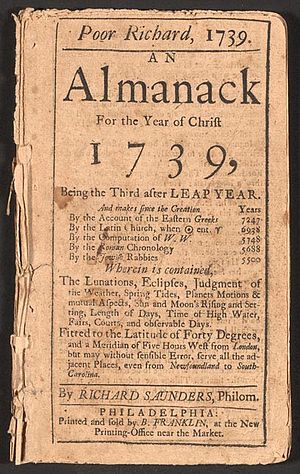 |
| "Poor Richard's Almanac" made Franklin's Fortune, and it can make yours. Read Franklin's "The Way to Wealth." It collects Franklin's sayings and advice on how to become wealthy. Maybe you can retire, like Franklin, at 42. He will tell you how in his Autobiography. |
Remember, like most of the literature you are reading, Franklin is meant to be read in very small, logical sections. If you try to read it all at once, chances are, you'll hate it. He thought people would be reading him aloud, stopping and talking about what he had to say,

No comments:
Post a Comment