Wednesday, October 31, 2012
Week Seven: Hurricane Sandy Update
Three students have contacted me concerning hurricane related internet and power outages. Usually, I operate under the theory that when three students are proactive and contact me concerning a problem, there are several more experiencing the problem, but the students who did not contact me are trying to tough it out out on their own.
I always build in a couple of catch up weeks into each online course design. To give the students experiencing problems because of Sandy a chance to stay caught up with the class, I'm going to use one of these for week seven. This will also give an extra week for students to submit missed or late assignments.
I will, however, post two committee discussions for the week, both dealing with Franklin's "bold and arduous" plan for moral perfection and his essay, "The Way to Wealth." For those who haven't had a chance to finish Franklin's Autobiography yet, his bold and arduous plan is found in the second section of the Autobiography. One committee discussion topic will ask your committee to discuss what civil/public virtues a successful democratic republic must cultivate in its citizens; equally important, given our freedom from religion and the necessity of not having a state church, how does society insure enough citizens learn these shared values/virtues/character traits while maintaining freedom of thought and maximum liberty? The second committee discussion thread will ask you to discuss what private, personal virtues you believe you need to cultivate to live the good life in today's America, and how do personal virtues needed to live the good life compare and contrast from the thirteen Franklin lists in his "bold and arduous" plan?
Steve

Wednesday, October 24, 2012
On Reading Franklin
 |
| The Portrait Franklin Commissioned as America's Representative in France. Notice how Franklin's Beaver Hat and Drab Clothing would have contrasted with the court dress in Paris. He made himself stand out. |
Few people represent their time and place as well as Franklin. He carefully constructs and projects an image of himself as a typical American. He starts from humble beginnings. Through hard work and careful frugality, he acquires a fortune, and he then "retires" to devote himself to public projects and a life dedicated to civic projects. Along the way, he introduces the first public fire department and library in America, forms a college, becomes a noted scientist and inventor, creates a musical instrument, and helps to author and facilitate a new nation; and, don't forget his scheme for obtaining moral perfection and kick starting the fight against American Slavery. Don't forget that he designs America's first money--with the mottoes "Time Flies," "We are One," and "Mind Your Business," not "In God we trust" This motto waited until the Civil War, and America needed to see itself as acting under God's plan in destroying slavery, but--remember--it was Franklin who helped start one of the first Abolitionist societies in America. Not bad for a guy who starts his public life as a runaway apprentice.
 |
| Designed by Franklin, this was the first money produced by the new nation. Notice that American Motto, "Mind Your Business." Notice the pun built in, that is, Fugio or Time Flies an so does money, that is, unless you "Mind Your Business. I'll let you research the other symbolism on the coin. |
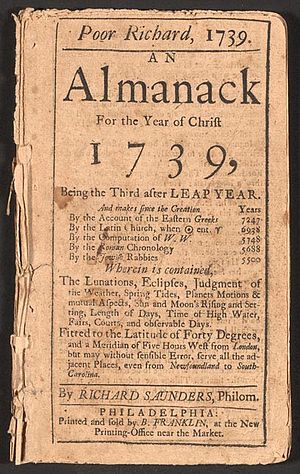 |
| "Poor Richard's Almanac" made Franklin's Fortune, and it can make yours. Read Franklin's "The Way to Wealth." It collects Franklin's sayings and advice on how to become wealthy. Maybe you can retire, like Franklin, at 42. He will tell you how in his Autobiography. |
Remember, like most of the literature you are reading, Franklin is meant to be read in very small, logical sections. If you try to read it all at once, chances are, you'll hate it. He thought people would be reading him aloud, stopping and talking about what he had to say,
Tuesday, October 23, 2012
Tuesday, October 16, 2012
Romanticism, Antebellum American Magazines, and the Fight Against Slavery
A student emailed a question which reminded me of an excellent, if disturbing, digital resource on American slavery and Romantic Literature, namely, the articles published by Harper's Weekly. Harpers was an early, illustrated magazine. Initially, the magazine became famous for publishing American (as opposed to British) authors, but as the technology for printing illustrations changed in the 1840s and '50s, so did the magazine.
Just as modern photojournalism and TV-journalism changed how many modern Americans regard war, these early, illustrated articles in Harpers helped to change how many Americans of the Antebellum period regarded slavery and a number of other reform issues. You can think of these articles as part of the Romantic struggle to help people feel more deeply and to sympathize with others.
Below is the link to the digitized collection, and I'll follow it by an image from one of the articles on the capture of the Wildfire, a slave ship. Here's the link: http://blackhistory.harpweek.com
What most modern Americans don't know is that the Trans-Alantic import or export of slaves was outlawed in the United States long before the Civil War; it was outlawed in 1808. While outlawing the import and export of slaves did little to change the condition of slaves in the United States, it was an essential, early, moral victory for the Abolitionist movement.

American Romanticism and the Role of Nature and the Land in the American Sublime

Look at "The Oxbow," above, Cole--its creator--painted in the 1820s and '30s. Now, look at the following image from 1872, just after the era we are studying in Early American Literature ends. The painting below is called, "American Progress," and it shows the movement of "America," an "civilized" America imagined as pushing back the darkness of the wilderness, opening the land for trains, wagon trains, and settlement. By the 1870s, there was a sense that the land would and could be conquered. It no longer seemed as overwhelming to those who attempted to imagination it, and there was a sense that "progress" would win out. The earlier Romantics were less sure, and it shows in their art:

From the 1820s-1850s, the Sublime found in Nature and the Wilderness was, in part, invoked by an unresolved reaction and awe at the size of American landscape, how much of it remained unknown and unsettled, and at the power of Nature over humankind; however, this intimidation was balanced by a sense of sublime awe in American "progress" and what was being done to tame the wilderness and bring "light" and "civilization" to the land. These images of the land were in a dynamic, unresolved tension throughout the American Romantic era, and they remain a part of the American relationship with the land and the notion of frontiers today.
Where did Thoreau's vision in "Walking" and in Walden fit into these different ways of viewing the land?
Extra-Credit for those who visit the VMFA, examine paintings from the Civil War and American Romantic Period and discuss how they represent the sublime and the American landscape.
How American Romanticism and Seeking the Sublime Helped Bring about Social Reforms, Like Slavery
As was usual in the Early Republic, America was behind the times, and America's own fascination with Romantic Philosophy and Art lagged behind Europe by about half a generation. This lag time allowed American Romanticism to develop in more sophisticated ways than its European counterparts (there's much debate on this point) and to avoid many of the worst aspects of Romanticism as it was expressed in Europe. For instance, Lord Byron was a kind of poster child for the Brooding, Bad Boy Romantic artist. Here, think bad boy singer or movie star. If you've ever wondered where one of the prototypes for today's teenage Vampires came from, look no further than Lord Byron. His life does not end well, and the excesses of his life became the stuff of tabloid legend. Another example can be found in Samuel Coleridge, who took drugs to attempt to find an easy road to the sublime. Byron found the sublime in fame; Coleridge sought the sublime in drugs. Regardless, both were looking for moments which overwhelmed and let them feel as if they were living as intensely as possible.
As it began to explore Romanticism, America managed to avoid most of the worst of these excesses. The closest we came to Lord Byron or Coleridge was Edgar Allen Poe, and Poe was not anywhere as bad as his press has made him out to be. We've all heard that Poe was into drugs and a drunkard, but recent evidence and critical analysis of his life has uncovered much of Poe's legend was hype put together by a publisher who wrote a biography of Poe after Poe's death. Poe had insulted this publisher by writing a scathing review of the publisher's earlier writing, and the myths and invective about Poe were largely vindictive, and they went unchallenged because Poe didn't have much in the way of family to defend him. Poe was no more or no less than a young writer trying to make a living as one of the first Americans to adopt the profession of letters, that is, to try and to make a living by writing. Prior to cheap paper and rotary printing, making a living by one's pen in America was nearly impossible, and Poe's continued problems with money were as much due to the fact that he was trying to figure out how to make a living with few models to pave the way as to the fact of the various lifestyle choices he made. Writing has rarely payed well, and it paid even worse before international copyright (1851). Poe was late in life before his particular means of helping his readers find the sublime--horror, madness, killings, the loss of beautiful lovers--began to catch on and had sufficient, consistent outlets. In fact, Poe made a much better living as a critique and an editor than he ever did as a writer.
Because America started late, American Romanticism tended to take on a more optimistic character than its European counterpart. Politically, the idea was that Romantics would change society one individual at a time, and they would made these changes by helping their readers feel more intensely. Most American Romantics tended to be optimistic, to seek beauty, and to try and help Americans feel and act for others. Like their European counterparts, American Romantics believed strongly in the immense power of the individual's imagination, insight, intuition, and cultivated ability to feel. The idea that was by helping others to feel strongly--even by making them feel horrified (as with Poe)--the Romantic artist would help their readers feel strongly for others and learn to care for others more. By learning to feel with and for others, those influenced by Romantic art would come to be more caring citizens, and America could begin to temper the developing strain of "I am in this only for my own benefit." Many Romantics also hoped that by helping people to appreciate Nature more, they would influence others to create beauty. This last strain of Romanticism was operating against the early factory system and the beginnings of urbanization. Where American Romantics differed from most European counterparts is that Americans believed that every individual had a unique genius and ability to feel strongly, and Americans tended to celebrate all individuals, not just the Romantic genius.
By providing a consistent philosophical framework to justify deep feeling--a framework that dovetailed well with the idea that all are created equal and, hence, helped to cultivate a uniquely American culture--American Romantics created the conditions where people would feel strong enough to go out and actively fight evils like slavery, child labor, poverty, and lack of public education. It is no accident that the great progressive movements in America began in the Romantic era. They would also encourage Americans to begin defining a culture which didn't lag behind and follow Europe but would celebrate the unique American landscape and the society which was still developing. In the process, Romantics would add into the American tradition our celebration of the underdog, our wanting to help others who are perceived as needing our help, and--for good or bad--Romantics would help temper the idea that public discourse and debate should be based solely on reason and fact. It was also in the Romantic period that Americans came to see it as their Manifest Destiny to conquer the Continent, so that the "great American experiment" might have room to succeed. The Frontier and the Pioneer settlers took on larger than life roles as Romantic figures of one aspect of what it means to be American, and the great American West was born.
What aspects of your character and that of America can you trace to the American fascination with intense feelings and the legacies of Romanticism?
So far, you've seen the American search for the sublime take on the form of horror (Poe), the search for one's best self (Emerson), an intense focus on the unique in each individual (Emerson), and trying to figure out how to cultivate the full engagement of the individual with the spiritual and social world (Thoreau). Over the next few weeks, we'll begin to explore how Romanticism influenced the political and social aspects of Antebellum America.
Wednesday, October 10, 2012
Checklist of Assignments Due: Week's One-Four
Earning some extra-credit for herself, a student wrote to ask me for a checklist of all assignments due weeks one through four. You can find it below.
Each Tuesday, if you print off the weekly assignment descriptions and read through them, you can plan out your week and check off each reading and writing exercise as it is completed.
Trying to do everything in one night is nearly impossible for a three credit hour, writing intensive course. There's too much reading, thinking and writing involved. Spread the work throughout your week and plan one or two exercises and part of the reading as part of every day.
Here's the promised checklist:
Week One: Unless otherwise stated, all work is due on Monday at midnight following the Tuesday it was assigned. Because students are still joining the class the first week, work for week one was due Monday, 2 October at Midnight, but--if possible--you should try to complete it by Monday, 24 September at Midnight.
1. Purchase texts for the course.
2. Set up personal gmail account.
3. Share the email address of the personal google account you will use for the class.
4. Explore eng241fall2012.weebly.com, that is, the site used to implement the class.
5. Read assigned literature for the coming week.
6. Find your committee of correspondence assignment for the semester on the “General Assembly” tab of the class webpage.
7. Under the week one discussion thread for your committee, post an introduction of yourself and in a follow up response, discuss possible extra-credit you might be interested in sharing with your committee.
8. Read all class announcements.
9. Write Dr. Brandon with any questions.
Week Two: All work due on Monday, 2 October at Midnight.
1. Create a blog you will use for the course. On this blog, you will post short essays and learning reflections you will write. Blogs are created, so your committee can have easy access to you writing for comment and to help them learn. Blogs will also be used to help you learn about the revolutions in literacy (the move from an oral to a print culture) and the impact of cheap printing on creating American literature and America.
2. Using an online form, share the web address of the blog you create.
3. Post to your blog an essay of ~750 words in which you describe America and what it means to be America. In your essay, use the reading from week one as a source to drawn on.
4. Read all class announcements.
5. Review the literature and announcements from Week One.
6. Read all assigned literature for the upcoming week.
7. Explore the extra-credit for Edgar Allen Poe, found under the “Extra-Credit” tab.
8. Under the Week One discussion thread in your committee’s coffee house forum, continue to introduce yourselves and discuss possible extra-credit.
9. Write Dr. Brandon with any questions.
Week Three: All work due by 8 October at midnight.
1. In a post to your committee’s Week Three, Part One discussion thread, compare and contrast your committee’s essays on America and what it means to be American to that of de Crevecoeur's essay. Your committee’s essays were posted to their blog on week two. Links to your committee’s blogs can be found under the “General Assembly” tab. Over the next couple of weeks, make sure to write follow up responses to at least two of committee member posts.
2. In a post to your committee’s Week Three, Part Two discussion, create a post in which you describe your moment of the Romantic sublime. Over the next couple of weeks, write follow up responses to your committee’s initial posts on their sublime moments.
3. Read Emerson’s essay, “Self-Reliance” for this week.
Post to your blog a 500-750 word essay in which you describe your best self. In your essay, use Emerson’s “Self-Reliance.”
4. For next week, read Thoreau’s “Walking” and “Where I Lived, and What I Lived For.”
5. Read class announcements for the week.
6. For attendance purposes, fill out a questionnaire/survey.
7. Write Dr. Brandon with any questions.
Week Four: All work for this week is due by Monday, 15 October at Midnight.
1. Read all class announcements/lectures.
2. Review Thoreau’s “Walking” and “Where I Lived, and What I Lived For” from week three.
3. Read background literature for coming week.
3. To your week four committee discussion thread, post one response to the discussion topic and at least two responses to what other committee members have to say.
4. To your blog, create a post containing a learning reflection.
5. To your blog, create a post containing a short, ~500 word essay.
6. Write Dr. Brandon with any questions.
Each Tuesday, if you print off the weekly assignment descriptions and read through them, you can plan out your week and check off each reading and writing exercise as it is completed.
Trying to do everything in one night is nearly impossible for a three credit hour, writing intensive course. There's too much reading, thinking and writing involved. Spread the work throughout your week and plan one or two exercises and part of the reading as part of every day.
Here's the promised checklist:
Checklist of Assignments by Week: Weeks One-Four
Note: Detailed descriptions and discussion of each reading and writing assignment can be found in the weekly assignment descriptions on the “Weekly Assignments” tab of eng241fall2012.weebly.com. This is where you find out what to read and write about and not just what is due.Week One: Unless otherwise stated, all work is due on Monday at midnight following the Tuesday it was assigned. Because students are still joining the class the first week, work for week one was due Monday, 2 October at Midnight, but--if possible--you should try to complete it by Monday, 24 September at Midnight.
1. Purchase texts for the course.
2. Set up personal gmail account.
3. Share the email address of the personal google account you will use for the class.
4. Explore eng241fall2012.weebly.com, that is, the site used to implement the class.
5. Read assigned literature for the coming week.
6. Find your committee of correspondence assignment for the semester on the “General Assembly” tab of the class webpage.
7. Under the week one discussion thread for your committee, post an introduction of yourself and in a follow up response, discuss possible extra-credit you might be interested in sharing with your committee.
8. Read all class announcements.
9. Write Dr. Brandon with any questions.
Week Two: All work due on Monday, 2 October at Midnight.
1. Create a blog you will use for the course. On this blog, you will post short essays and learning reflections you will write. Blogs are created, so your committee can have easy access to you writing for comment and to help them learn. Blogs will also be used to help you learn about the revolutions in literacy (the move from an oral to a print culture) and the impact of cheap printing on creating American literature and America.
2. Using an online form, share the web address of the blog you create.
3. Post to your blog an essay of ~750 words in which you describe America and what it means to be America. In your essay, use the reading from week one as a source to drawn on.
4. Read all class announcements.
5. Review the literature and announcements from Week One.
6. Read all assigned literature for the upcoming week.
7. Explore the extra-credit for Edgar Allen Poe, found under the “Extra-Credit” tab.
8. Under the Week One discussion thread in your committee’s coffee house forum, continue to introduce yourselves and discuss possible extra-credit.
9. Write Dr. Brandon with any questions.
Week Three: All work due by 8 October at midnight.
1. In a post to your committee’s Week Three, Part One discussion thread, compare and contrast your committee’s essays on America and what it means to be American to that of de Crevecoeur's essay. Your committee’s essays were posted to their blog on week two. Links to your committee’s blogs can be found under the “General Assembly” tab. Over the next couple of weeks, make sure to write follow up responses to at least two of committee member posts.
2. In a post to your committee’s Week Three, Part Two discussion, create a post in which you describe your moment of the Romantic sublime. Over the next couple of weeks, write follow up responses to your committee’s initial posts on their sublime moments.
3. Read Emerson’s essay, “Self-Reliance” for this week.
Post to your blog a 500-750 word essay in which you describe your best self. In your essay, use Emerson’s “Self-Reliance.”
4. For next week, read Thoreau’s “Walking” and “Where I Lived, and What I Lived For.”
5. Read class announcements for the week.
6. For attendance purposes, fill out a questionnaire/survey.
7. Write Dr. Brandon with any questions.
Week Four: All work for this week is due by Monday, 15 October at Midnight.
1. Read all class announcements/lectures.
2. Review Thoreau’s “Walking” and “Where I Lived, and What I Lived For” from week three.
3. Read background literature for coming week.
3. To your week four committee discussion thread, post one response to the discussion topic and at least two responses to what other committee members have to say.
4. To your blog, create a post containing a learning reflection.
5. To your blog, create a post containing a short, ~500 word essay.
6. Write Dr. Brandon with any questions.
Tuesday, October 9, 2012
Week Four Assignment Descriptions and Discussion Thread Now Active.
Enjoy. This week, expect a more detailed introduction to American Romanticism, Thoreau and Emerson. We'll also begin the background reading to best understand the various roles American Romantic literature played in the fight against slavery and in motivating so many to fight slavery in the Civil War.
Steve
Steve
Tuesday, October 2, 2012
Questions about the course? Need Help Setting Up Your Blog or Posting?
As of this morning, eighteen students have successfully set up and shared their blog with me. Thank you so much. In an equally brilliant move, two students who were new to blogging and wanted some additional help wrote and set up an appointment to sit down with me today, following the college's convocation. They decided to meet me in my office.
If you want similar help with your blog or have other questions about the course, please get in touch with me. Tomorrow, Wednesday, 3 October, I've got some time free in the afternoon to meet with students. Contact me for an appointment using one of the "Contact Me" forms of email me at sbrandon@reynolds.edu to schedule a time which will work for us both.
Steve
The "Early" in "Early American Literature": Imagining America Anew
(Please note: scroll down below this essay/lecture to earlier entries to see a discussion of week one assignments and the "What is American?" essay assignment and reading.)
Take a couple of minutes and consider the following, 1507 map of the world. This map of the world--bought by the US a decade or so back and now on display in the Jefferson Building of the Library of Congress (Extra-Credit filed trip opportunity)--contains the first time the word "America" is applied to the land which was in the early 1500s new to all of Europe. In looking at this map, consider how it is centered on Europe and on how detailed the section on Europe is when compared to the other sections of the world. The level of detail on a map is a good index to what is known and what the map maker can imagine.
Now take a moment to look at how little was known of the Americas in 1507. Getting your head around the fact that America didn't exist in the European imagination until the late 1400s and that the rest of the world was a fuzzy concept will take you a long way toward understanding why and how our own, Euro-centric influenced imagination of America came into existence. America was a new world, seeming to appear out of no where and changing almost everything about Europe in only a couple of hundred years.

Here's an article on this 1507, Waldseemüller map. Follow the link, and you'll be able to see a nice closeup of the section on America.
Now take a look at what was America in 1507. Look closely at what was there; consider all that isn't. What you see is what Europeans thought the Americas were. That narrow strip of land east of Europe. Notice that there are water routes between what would become North and South America. Notice that folks know more about South America than North America. That's because the Portuguese were better navigators than--originally-- the Spanish could hire. Notice how large the what would become Cuba and the Caribbean is in the European imagination of the early 1500s. What you are seeing is something as real to the Europeans of 1500 as our own conceptions of the world and America and Europe are to us today.
It seems arrogant of Renaissance Europeans to make the claim to have discovered America. It is not not as if other people were not here first. I don't know if you've ever traveled or moved to a new city and experienced how the city starts off in your imagination as a vague image nor do I know if you've experienced how how one builds up an increasingly realistic image of the city over a stay. I don't know if you've ever experienced getting lost fewer times or stumbling on a place you've never visited in a city in which you've lived your whole life. If you have, you've had experiences which can help ground your understanding of the process of discovery of America which went on from the late 1400s throughout the period we'll be studying in this survey of Early American Literature.
More than anything else, it is this process of discovering America--the land, the people, and the effect of continual discovery on what would become a distinctly American people and society--that is a back drop which governs everything about the literature, the time period, and the lives of each individual we will be studying. Just like you and me, at every moment along this centuries long journey, most people thought they knew just what America was, but they didn't. At the beginning of this process of discovering, what we think of as America literally didn't exist in any imagination. Through the process of discovering and exploration of the new land--of mapping the land, experiencing it, figuring it in their literature. and (most important) living on the land and among the people of the land--Europe and the whole world would be altered. Thoughts which well may never have been thought by Europeans alone were thought.
The first thing you need to understand is that like maps, literature doesn't represent the actual land; instead, maps and literature represent how we imagine the land and the possibilities most of us allow ourselves to explore and experience. While we try to align our imagination with the actual, what is there is almost always more than we can imagine. Consider this following map. It was produced in the 1780s, the same decade de Creveceour's "What is American?" letter was published.

This map represents the America de Creveceour held as the real and actual America. That was the America de Crececeour wrote about and which we can experience in his writings; yet, when he says, "American," we can't help but understand him using our own imagination of America. When comparing the 1507 and 1780s maps, the first thing a modern viewer notices is how vague the area west of the Rockies is. If one looks closely, one sees the map makers of the 1780s still thought there was a good possibility of a Northwest water route to Asia. Well after 1780 at Monticello, Jefferson had the bones of a mmastodons, and he thought that those who explored the interior of North America were likely to see mastodons in their travels. In the 1780s, the United States did not own this interior. For almost every European and those of European descent, the interior of North America was there, but the details waited to be filled in. This doesn't mean that lives were not lived on the land, but it does mean that--at least in the European imagination--these lives had little impact.
In 1780, the United States of America was an upstart little country of thirteen scrabbling states. What became the United States was only beginning to cast off the idea that these were English colonies, and these newly declared, sovereign states had only the first glimmer of an idea of what it meant to live in a democratic republic where "all men were created equal." In fact, those words were less than a decade old. The nation was just adopting the idea they were of America and not of Europe. This new nation huddled on the east coast of a continent which was still waiting to be fully explored by those of European descent. Twenty years later, when Jefferson was president, the Lewis and Clark Expedition would test his theory that mascadons wandered the west, and they would close down the imagination of a cheap water route between Europe and Asia--allowing other imaginations of this water route (think Panama Canal) to take form. It won't be until the 1890s--three decades past the end of period we'll be studying--when the United States, then coming up on 150 years old, would say the North American Frontier was settled. Even then, they would mean settled by those of European descent.
Discovering what is American was a process which took centuries, and it still goes on. I've stood on on a west Texas US Highway in the wee hours of the early morning and wondered that all I saw were stars. There was not a single car on the road. There was not a single light to be seen from a farmstead. All there was was road, the stars, and the brush. I felt small, and I knew something of the awe with which Americans must have once viewed the land. It was smaller in my own imagination than it proved to be.
To Europeans, America in 1507 was an unexpected strip of land between Europe and trade with East Asia. To Europeans and those of the newly minted United States of America, America in 1780 was a continent full of Native peoples with areas still to be explored and settled, and there was still a possible water route between Europe and Asia; however, by 1780, America had become a place to live for European immigrants, one associated with more opportunity and more civil freedoms than were available to most of the common people of Europe. Most important, the land and the living here had begun to change those who came to experience. I was a different man after than night on that west Texas road than I was the day before. The experienced changed my relationship to America. What I could imagine became larger and more hopeful. America chances us. It challenges us to be bigger than what we once could imagine.
The literature we'll be studying this semester encompasses the period between Columbus's contact with what he thought were the Indies (1492) and the closing of the American Frontier in the 1890s. We'll be looking at the literature produced between 1492 and 1867, and we'll try to explore the notion of the role this literature plays in who've we become and in the possibilities we imagine for ourselves. May our journey be a rich one, and I hope each of us is changed. I hope we can each discover a new found land and a new America.
Additional information on "What is an American?" Essay.
A student wrote me and asked for additional information on the essay, "What is American?" Below find my reply:
The basic idea of this essay is--at first--fairly straight forward. Pretend you are writing to someone in 2012 who is considering immigrating to America. They only know what they've heard about America, but they have never visited. Explain what is American and what it means to you to be American. You would think that folks living in America for any length of time would know what it means to be American, but the task of explaining it to another requires us to distill our knowledge. In the process of distilling it for another, we clarify it for ourselves. Distilling some of the ideas behind what it means to be American and the role played by literature in defining America is a lot of what the study of American Literature is about. In particular, Early American Literature helps us better understand who and what America is.
Defining what is American for himself and would be immigrants is the task that de Creveceour set out for himself in the late 1770s and, in specific, in Letter III of Letters from an American Farmer. In particular, he was writing back to France and to others who were struggling with understanding how the ideas which produced the American Revolution came into being among a scattered diverse group of colonists. In a few years, France would be in the throws of its own Revolution, where the French tried to put in place democratic ideals in a land where almost of the institutions revolved around privilege and hierarchy. Defining what is distinctly American is a surprisingly difficult task to accomplish when you put any kind of limitations on length, because you are then limited in the approach you can take, and the topic is not one easily captured. You've a minimum of 750 words. My advice is to carefully consider what being American means to you and why you hold these ideas. This is again the approach de Creveceour took. You might carefully consider what he said and talked about, and adopt his approach. Extra points on the essay if you can ground part of what you have to say in the reading you have done for our class. Remember to cite all the use of sources.
Right now, I want you to be thinking of the term "American" and struggling with what you think the term means. As you read the literature over the fall, your take on what being American is should develop, get challenged, and change. You'll be reading the documents produced by those new to America, those who defined the Revolution against England, those who struggled to create the original documents which defined the United States, those who struggled with establishing the American relationship between the individual and society, those who struggled with the relationship between the individual, American society, and the land, etc. Each of these struggles helped to define who you and I are today.
Steve
The basic idea of this essay is--at first--fairly straight forward. Pretend you are writing to someone in 2012 who is considering immigrating to America. They only know what they've heard about America, but they have never visited. Explain what is American and what it means to you to be American. You would think that folks living in America for any length of time would know what it means to be American, but the task of explaining it to another requires us to distill our knowledge. In the process of distilling it for another, we clarify it for ourselves. Distilling some of the ideas behind what it means to be American and the role played by literature in defining America is a lot of what the study of American Literature is about. In particular, Early American Literature helps us better understand who and what America is.
Defining what is American for himself and would be immigrants is the task that de Creveceour set out for himself in the late 1770s and, in specific, in Letter III of Letters from an American Farmer. In particular, he was writing back to France and to others who were struggling with understanding how the ideas which produced the American Revolution came into being among a scattered diverse group of colonists. In a few years, France would be in the throws of its own Revolution, where the French tried to put in place democratic ideals in a land where almost of the institutions revolved around privilege and hierarchy. Defining what is distinctly American is a surprisingly difficult task to accomplish when you put any kind of limitations on length, because you are then limited in the approach you can take, and the topic is not one easily captured. You've a minimum of 750 words. My advice is to carefully consider what being American means to you and why you hold these ideas. This is again the approach de Creveceour took. You might carefully consider what he said and talked about, and adopt his approach. Extra points on the essay if you can ground part of what you have to say in the reading you have done for our class. Remember to cite all the use of sources.
Right now, I want you to be thinking of the term "American" and struggling with what you think the term means. As you read the literature over the fall, your take on what being American is should develop, get challenged, and change. You'll be reading the documents produced by those new to America, those who defined the Revolution against England, those who struggled to create the original documents which defined the United States, those who struggled with establishing the American relationship between the individual and society, those who struggled with the relationship between the individual, American society, and the land, etc. Each of these struggles helped to define who you and I are today.
Steve
Subscribe to:
Posts (Atom)